Robotics / Project
Soft Gripper Weight & Rigidity Optimization
A flexible robotic end-effector for fruit and vegetable harvesting. I took the gripper finger from 130 g to 71 g through iterative topology optimization, then reworked the optimizer's output into geometry that could actually be printed — without losing the compliant grip that keeps delicate produce undamaged.
Project Type
University Project (MSE 812)
Technologies
SolidWorks • Topology Optimization • FEA • FDM 3D Printing
My Role
Topology Optimization, FEA & Design for 3D Printing
Overview
Weight you can't remove without touching the thing that makes it work.
Completed as a three-person team project, this project designed a flexible end-effector for robotic fruit and vegetable harvesting — a gripper that conforms to irregular produce while holding it firmly enough not to drop it and gently enough not to bruise it. Mass at the end of a harvesting arm is the mass that costs most to move: it sets actuator sizing, cycle time, and arm inertia.
My piece was making the finger lighter. What makes that difficult in a compliant gripper is that weight and function aren't separable — the finger grips by bending, so every gram of material removed changes the mechanism itself. There is no safe interior to hollow out.
Design Requirements
Specific Requirements
Harvesting fruit and vegetables is still largely manual, driving up labor costs and limiting throughput. Flexible end-effectors can adapt to a wider range of object shapes than rigid grippers, but often trade away grasping force or rely on expensive specialty materials to get that flexibility. The project defined five requirements to guide the design.
01
Size & Scalability
Accommodate a range of object sizes and shapes.
02
Material Selection
TPU, TPE, or flexible PLA.
03
Geometry
Flexibility and deformation while maintaining structural integrity.
04
Robustness & Reliability
Stress analysis and simulation to confirm the design withstands repeated use.
05
Texture & Surface Finish
Enhance grip and friction against the object.
Background Research
Learning From Existing Soft-Gripper Designs
Before settling on a design direction, the team reviewed existing soft-gripper research, including a shape-memory-alloy gripper with variable stiffness, an octopus-inspired bionic gripper for apple grasping, a Fin-Ray-inspired gripper with fruit slip detection, and a bionic flexible end-effector for tomato harvesting. One consistent finding: controlled flexibility and slip feedback substantially reduced fruit damage compared to rigid designs — in one study, from a 20% damage rate down to 0% with force feedback enabled. The team then brainstormed a range of concepts, from tentacle and shape-memory-alloy grippers to pressurized and hinged finger designs, before narrowing toward a soft, geometry-based flexible finger. For fabrication, PLA was selected for its durability, relative flexibility, and cost-effectiveness, with TPU considered as a softer alternative.
My Contribution
Sweeping the constraint space, not running the optimizer once.
A single optimization run tells you very little — it gives you one point in a tradeoff space without telling you where that point sits. So I set the work up as a sweep. I built the FEA mesh, defined the material, set the grip hinge and the fixed outer border, then varied the displacement constraint from 0.8 to 1.5 and pushed mass reduction targets from 10% up to 80% across iterations.
Every candidate then went through a static stress simulation against the original finger under identical load conditions, so the question at each step was always what the design had lost, not whether the result looked plausible.
01
Mesh & Material
Built the FEA mesh and defined the base material for each optimization run.
02
Hinge & Border
Defined the grip hinge point and fixed outer border — the constraints that protect the bending behaviour through optimization.
03
Iterative Tuning
Varied displacement constraint (0.8–1.5) and mass reduction targets (10%–80%) across iterations.
04
Stress Validation
Ran static stress simulations on each candidate to select the best strength-to-weight iteration.
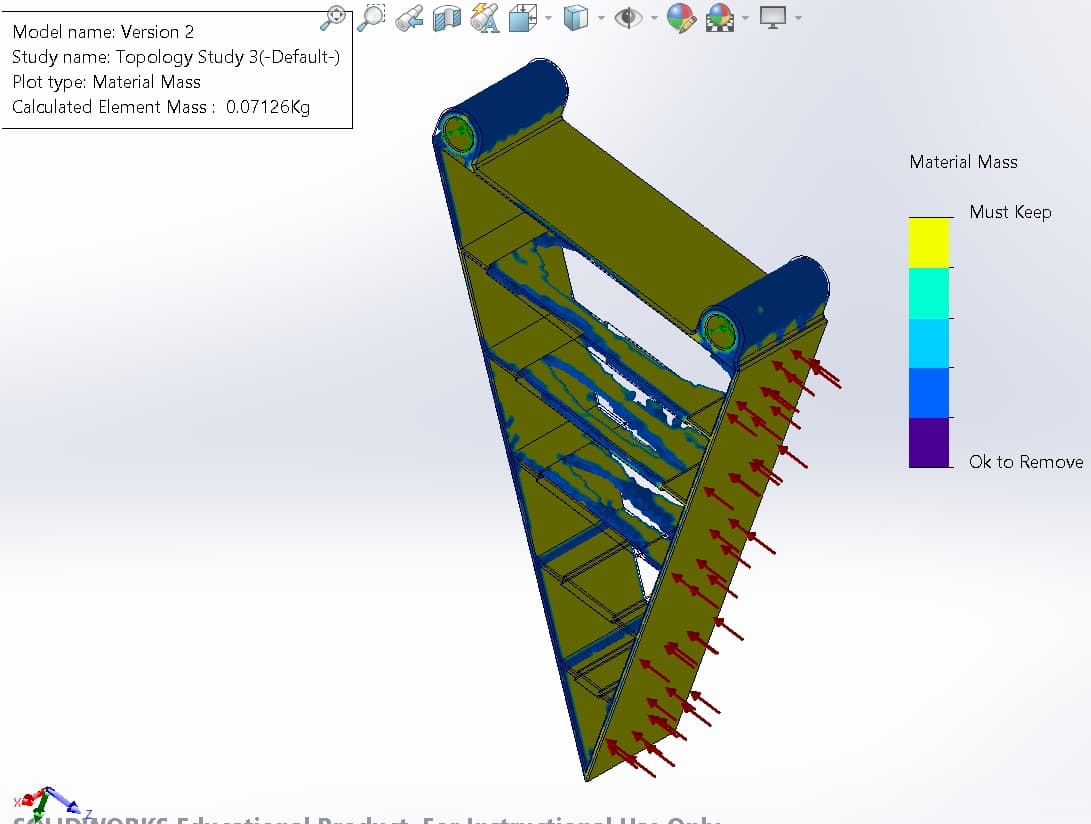
Material mass plot from one optimization iteration — yellow regions must be kept, purple regions are safe to remove. The study reports a calculated element mass of 0.07126 kg.
Design for Manufacturing
The optimizer doesn't know how the part gets made.
The aggressive iterations produced geometry that was lighter and, as far as the solver was concerned, correct — but not manufacturable. Topology optimization has no model of the FDM process, so it returns organic webbing with sharp transitions and features that don't survive contact with a nozzle and a layer height.
It also treats the part as isotropic, which an FDM print isn't — a printed part is markedly weaker across layer boundaries than along them. For a finger that grips by flexing in one direction and has to stay stiff in the others, that anisotropy isn't a defect to work around. It's a design variable.
So I treated the optimizer's material map as a guide rather than a result. The final finger is a redrawn part that keeps the load paths the solver identified, smooths the transitions it left sharp, puts material back wherever the geometry fell below what the process could reliably produce, and is oriented on the bed to put the layers where the bending needs them. That interpretation step is the part the software can't do.
Keep the load paths
The material the solver refused to remove shows where load actually travels. Those regions carried straight into the final geometry.
Soften the transitions
Raw optimizer output meets at abrupt angles that concentrate stress. Fairing those junctions costs a little mass and buys back durability.
Respect the process
Features finer than the extrusion width, or overhangs the printer couldn't hold, were rebuilt into forms that print cleanly in PLA.
Orient for the bend
The finger has to flex in one direction and resist load in the others. Print orientation was chosen so bending stress runs along the extrusions rather than across the layer bonds — the same anisotropy that would delaminate a flexure, used to bias stiffness where the design wants it.
Validation
Initial vs. Final Design Simulation
I ran static stress simulations on the original finger design and the final printable design under the same load conditions. Peak von Mises stress rose from 3.9 kPa to 199 kPa — still more than two orders of magnitude below PLA's yield strength — and the deformation scale dropped from roughly 15,500× to 258×, meaning the optimized finger deflects considerably further under the same load.
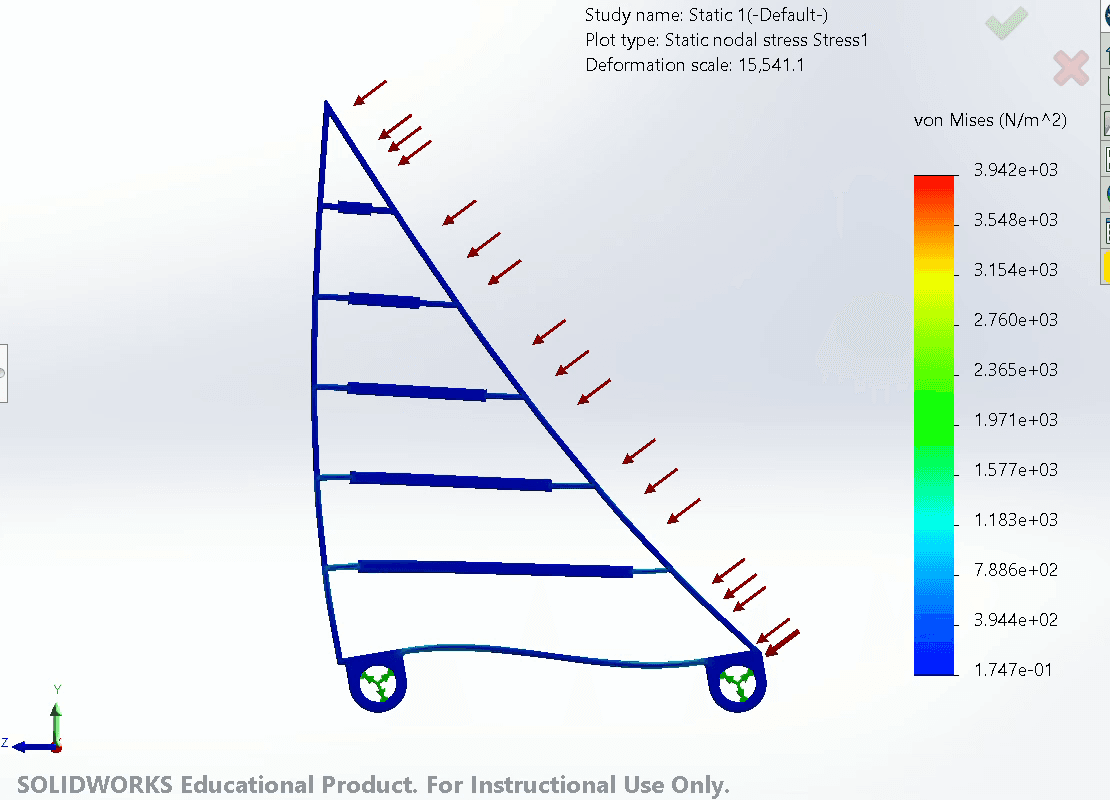
Initial design — peak 3.9 kPa, deformation scale 15,541×
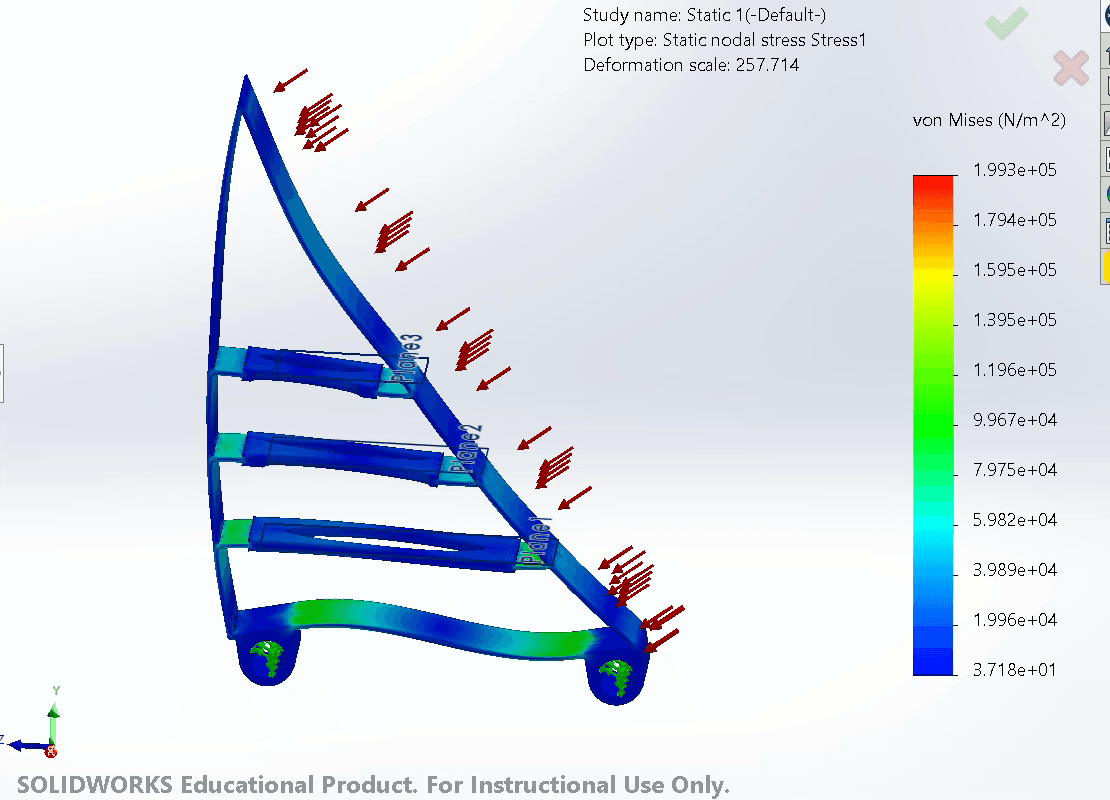
Final design — peak 199 kPa, deformation scale 258×
More deflection isn't a loss here — a finger that grips by bending is supposed to bend, and the extra compliance is the intended direction. Worth being precise about what this shows, though. The stress response is simulated and compared directly against the original. The compliant grip was preserved by constraint — through the hinge definition and displacement limits that shaped every optimization run — rather than measured. Force-deflection was never characterized on a rig.
Results
130 g to 71 g — and it prints.
59 g
removed from the finger, 130 g down to 71 g
45%
lighter, at a peak stress still ~250× below PLA yield
PLA
printed on FDM from the final geometry
The final geometry printed in PLA and was checked by hand — squeezing the finger to feel whether it bent the way the simulation predicted and sprang back. It did. That's a sanity check rather than a characterization, but it confirmed the part was real and that the compliance survived the material that came out of it.
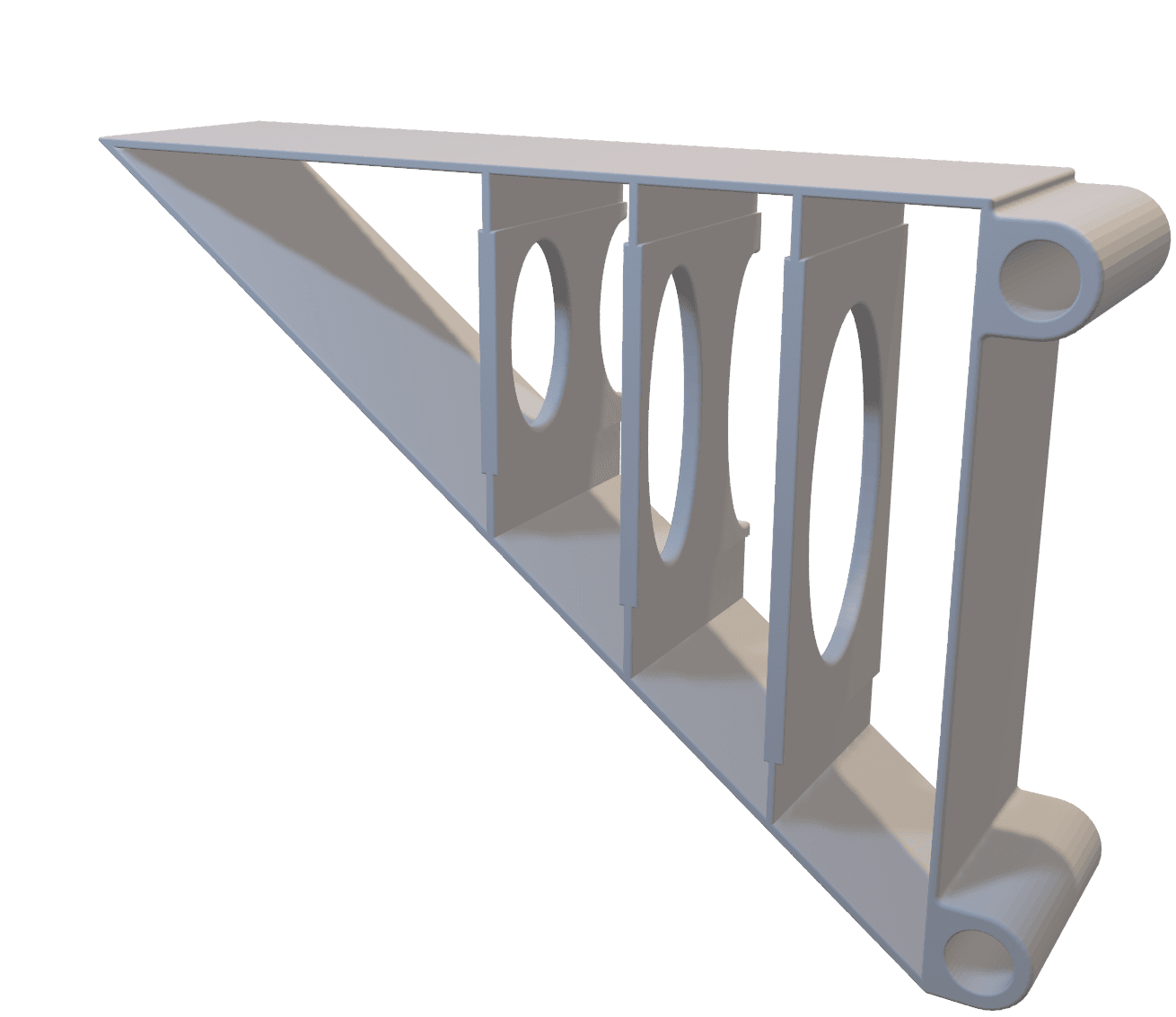
Final, print-ready geometry
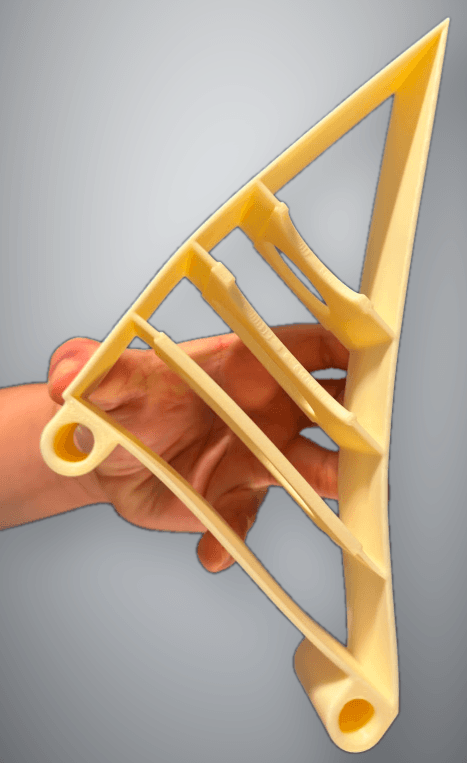
The printed finger in PLA — flexing under hand pressure
Limitations & Next Steps
What I'd do with another cycle.
The project ended at a printed part checked by hand. Three things would take it from a working prototype to something you could put on a harvester.
Characterize the compliance
Clamp the fixed border, load the fingertip in known increments, and measure deflection — producing force-deflection curves for the original and optimized parts to quantify what the 45% actually cost.
Cycle it to failure
A harvesting gripper closes thousands of times a day. Static stress says nothing about fatigue at the thinned sections, which is where a lightweighted flexure would be expected to go first.
Test against real produce
The requirement was gripping without bruising. That is ultimately a claim about fruit, and it needs damage rates across a range of sizes, ripeness, and surface conditions to be settled.