University Project / Robotics
Autonomous Weed Management Robot
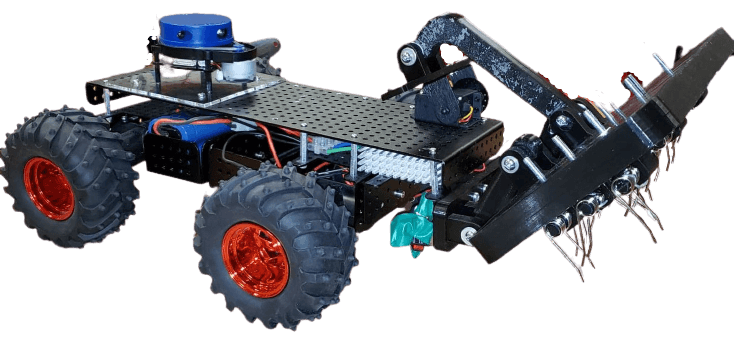
An autonomous agricultural robot designed to reduce manual labor in weed management by combining ROS-based navigation, 2D LiDAR mapping, embedded motor control, and a custom mechanical weeding mechanism.
Project Type
University Robotics Project
Navigation
ROS + Hector SLAM + 2D LiDAR
Platform
Wild Thumper Mobile Robot
Technologies & Skills
Project Overview
Combining autonomous robotics with mechanical weed removal.
The project focused on developing an autonomous ground robot capable of navigating a predefined environment while carrying a mechanically actuated weeding attachment.
The system combined a Raspberry Pi 3B+ running ROS, an Arduino microcontroller, a YDLIDAR X4, a Sabertooth motor controller, and a custom 3D-printed mechanical weeder.
The project required integration across mechanical design, embedded control, robotics software, sensing, autonomous navigation, and physical system testing.
The Problem
Reducing repetitive agricultural labor.
Weed management can require significant manual labor, particularly when weeds must be physically removed from growing areas.
Chemical weed control can also introduce environmental concerns and contribute to herbicide resistance.
The goal of this project was to develop an autonomous mobile platform capable of navigating an environment and performing physical weed removal with a mechanical attachment.
Engineering Solution
A modular autonomous robotic platform.
The robot was designed as a modular system where sensing, computation, motor control, navigation, and mechanical actuation were separated into functional subsystems.
01
Raspberry Pi 3B+
High-level computing platform running ROS and handling navigation, LiDAR processing, and robot communication.
02
Arduino
Low-level controller responsible for motor commands, servo control, and communication with the motor driver.
03
YDLIDAR X4
2D LiDAR sensor used for environmental scanning, mapping, and obstacle detection.
04
Sabertooth 2×32
Motor controller used to drive the differential-drive DC motors.
Mechanical Design & Fabrication
A custom mechanical weeding system designed and fabricated for the robot.
I designed and fabricated the mechanical weeding mechanism used by the robot. The mechanism was developed in SolidWorks, manufactured using 3D printing, and integrated onto the mobile platform.
01
Mechanical Design
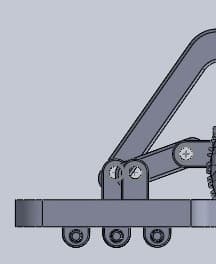
Designed the custom weeding mechanism in SolidWorks, considering the robot chassis, mounting points, linkage geometry, and required movement.
02
3D Printing
Fabricated 15 custom components using 3D printing to create the physical mechanism and mounting structure.
03
Mechanism Integration
Integrated the custom mechanism with the Wild Thumper chassis and incorporated servo-based actuation.
04
Testing
Tested the mechanical assembly as part of the complete robotic system and refined the design during development.

Mechanical Design
Designing the weeding mechanism.
The mechanical weeder was developed as a custom attachment for the autonomous mobile robot. I designed the mechanism in SolidWorks and developed the physical components through 3D printing.
The mechanism was inspired by a commercial tine weeder and used a spring tine mounted to a custom plate. A servo-driven parallel lift mechanism allowed the attachment to be raised and lowered.
The Wild Thumper chassis was also modified to accommodate the attachment. Two rear motors were removed to reduce electrical load and create additional space for the mechanical system.
Electronics & Control Architecture
Separating high-level autonomy from low-level control.
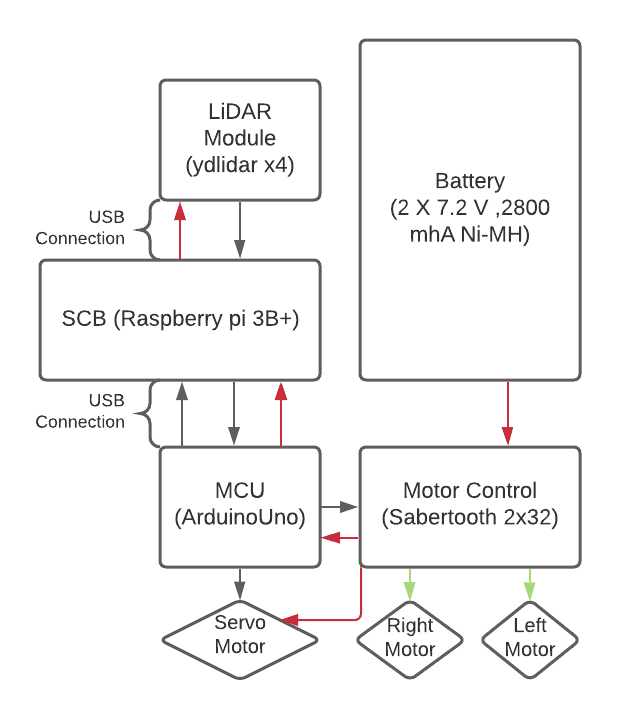
The robot used a two-level control architecture. ROS running on the Raspberry Pi handled high-level robotic functions, while an Arduino provided low-level control of the motors and servo.
High-Level Control
Raspberry Pi + ROS
• ROS master and robotic communication
• LiDAR processing
• Mapping and localization
• Autonomous navigation
• Teleoperation
Low-Level Control
Arduino + Motor Controller
• Motor control
• Sabertooth motor controller
• Differential-drive movement
• Servo control
• ROS serial communication
Control Flow
Autonomous Navigation
Mapping the environment with 2D LiDAR.
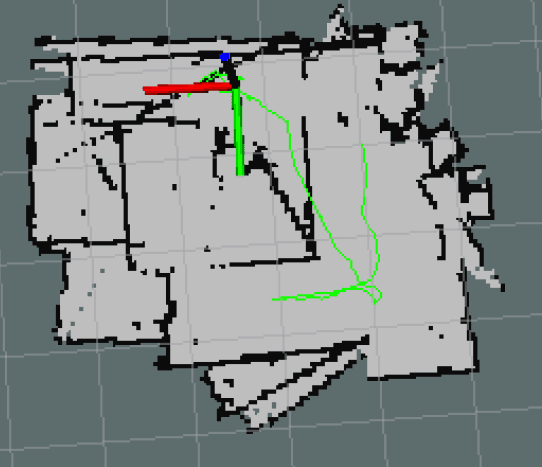
A YDLIDAR X4 was used to scan the surrounding environment and generate a 2D representation of the robot's surroundings.
The project implemented ROS Hector SLAM to construct a real-time map while the robot moved through the environment.
The resulting map could be visualized in RViz and saved for later use. This allowed the project to progress from manual control toward autonomous navigation within a preset environment.
01
LiDAR
Environmental scanning
02
ROS
Sensor communication
03
Hector SLAM
Mapping and localization
04
RViz
Visualization
05
Navigation
Autonomous movement
SLAM Mapping
Real-time environment mapping using LiDAR and Hector SLAM.
Software Development
Connecting perception, control, and navigation through ROS.
The software system was divided between ROS running on the Raspberry Pi and Arduino firmware responsible for low-level hardware control.
ROS Development
- • rosserial
- • rosserial_arduino
- • YDLIDAR package
- • Hector SLAM
- • C++ ROS nodes
- • cmd_vel differential-drive control
Arduino Development
- • Arduino IDE
- • Sabertooth library
- • ROS communication library
- • Motor control logic
- • Servo control
- • Differential-drive implementation
Testing & Validation
Building and validating the system incrementally.
The robot was developed through a series of incremental experiments. Each subsystem was validated before being integrated into the complete autonomous platform.
01
Motor Control
Tested Arduino control of the Sabertooth motor controller and verified basic motor operation.
02
ROS–Arduino Communication
Verified serial communication between ROS and the Arduino using ROS topics.
03
ROS Motor Control
Demonstrated differential-drive control using ROS cmd_vel messages.
04
LiDAR Integration
Successfully obtained LiDAR scans and visualized the surrounding environment in RViz.
05
SLAM Navigation
Generated a real-time map using LiDAR data and Hector SLAM.
06
Autonomous Operation
Demonstrated autonomous navigation within the preset development environment.
Results
Integrating mechanical, electrical, and software systems into one working prototype.
The completed prototype successfully integrated the mechanical, electrical, and software subsystems into an autonomous mobile robot.
ROS
Robotic communication and autonomous system architecture
SLAM
Real-time LiDAR-based mapping and localization
Mechanical Weeder
Custom 3D-printed physical weed-removal hardware
Motor Control
Arduino and Sabertooth-based differential drive
LiDAR
Environmental sensing and obstacle detection
System Integration
Combined hardware and software into a functional prototype
Validation Limitation
Due to seasonal timing, outdoor agricultural field testing was not performed. The project therefore demonstrated autonomous operation in a controlled environment rather than validating long-term field-weeding performance.
Challenges & Improvements
Identifying limitations and opportunities for improvement.
Mechanical
Chassis Maneuverability
The rectangular chassis required significant turning space. A circular or more compact chassis geometry could improve maneuverability in tighter agricultural rows.
Environmental
Environmental Protection
The main electronics were protected using a weatherproof enclosure, but the LiDAR and servo remained exposed to environmental conditions.
Navigation
Localization Improvements
Hector SLAM relied primarily on LiDAR. A future implementation could incorporate odometry alongside laser data to improve navigation robustness.
Computing
Processing Capacity
The Raspberry Pi 3B+ with 1 GB of RAM was sufficient for the prototype but could become a limitation as additional perception and autonomous applications are introduced.
Future Development
Expanding the platform beyond mechanical weed removal.
The modular ROS architecture provides a foundation for expanding the platform into a broader autonomous agricultural robotics system.
01
Computer vision and plant recognition
02
Plant-health monitoring
03
Alternative agricultural attachments
04
Improved mechanical weeding mechanisms
05
Advanced navigation and perception
06
Additional autonomous agricultural tasks
Skills Demonstrated
A multidisciplinary robotics project.
Robotics
- Autonomous mobile robotics
- ROS
- SLAM
- LiDAR
- Differential-drive systems
Embedded Systems
- Arduino
- Raspberry Pi
- Serial communication
- Motor control
- Servo control
Mechanical Engineering
- SolidWorks
- CAD design
- 3D printing
- Mechanical linkage design
- Robotic attachment design
Systems Integration
- Hardware/software integration
- Sensor integration
- Autonomous navigation
- Experimental testing
- Debugging & validation
Project Summary
Designed and built an autonomous agricultural robot integrating robotics, embedded control, autonomous navigation, and custom mechanical fabrication.
The project brought together mechanical engineering, electronics, embedded programming, ROS development, sensor integration, and autonomous robotics into a single functional prototype.